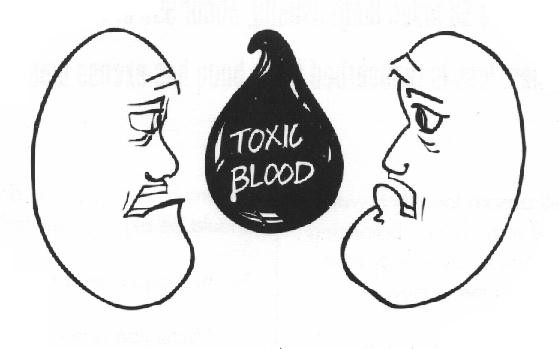
Saturday, May 14, 2011

So... how did you know you were in kidney failure?

This is a question I get a lot, and the easiest answer is "I didn't know". Everybody's body reacts differently to renal shutdown and failure can be chornic or acute. Hopefully for most people it's acute and the likelihood that their kidney function will resume is good. Chronic renal failure on the other hand is usually associated with am illness, infection or disease.

Most kidney trouble starts off with  renal insufficiency which means your kidneys are not able to clear as many waste products and water due to an ongoing or chronic problem. In my case, as I know now, was that I had high blood pressure since the day I was born. I was labeled a hyperactive child and at one point even given Ritalin. Every doctor's visit I can remember growing up my blood pressure elevated but it was written off as me being excitable or stressed because of the office visit.
 Over the course of 31 years,  the uncontrolled high blood pressure I had ended with both my kidneys completely failing and leaving me with what Doctors called end stage renal disease or ESRD.

Okay enough of the who what when where how.

In December of 2001 and went home to visit my family for the holidays. I could barely lift my suitcase let alone climb a flight of stairs. At our family holiday dinner, I was naseous and excused myself several times to go throw up. I knew I would have to return to New York by the afternoon of December 24 as I had a late night flight to work. A supervisor happened to be at the gate of my commuter flight when it arrived. He took one look at me said, "I'm putting you on the sick list, go home and get some sleep." and I did just that.
 
I got home around seven o'clock at night and fell asleep on the couch with the TV on. The next thing I know my roommate, Bettina, is shaking me awake. I remember looking at her and saying, "Wow your home early. Did your trip get canceled?" She replied, "No hun, it's the 26th." I stared at the ceiling and realized I'd been asleep for almost 36 hours. I tried to situp but couldn't feel my legs. I told Betina I need to go to the hospital and she helped me up, to her car, and drove me to the hospital. At the time I was 5'8" and 148 pounds. Looking back I was so thin, that should've been an indicator that something was wrong.
So we get to the hospital and by this time I can walk but I am in an incredible amount of pain. In the emergency room they drew some initial bloods and paged the nephrologist on-call. When my blood work came back, the doctor told me that my numbers were so high that I should already be dead. He was very surprised that I was not in a coma. That's when I realized I was in a coma for almost 36 hours.
I remember very clearly a nurse walking up to me and looking at my chart, and then asking the same questions everyone else had asked me. After I answered her questions she looked at me and said,"You don't look like you're in kidney failure."The symptoms of chronic renal failure are:

Change in frequency of urination with a marked change in color of urine
Decreased urine output with the need to urinate frequently / excessively at night
Bloating up of entire body (face, hands, legs, feet, ankles)
Constant feeling of tiredness, even while relaxing
Skin eruptions combined with severe itching
Loss of appetite
Bad breath
Severe nausea and vomiting
Constantly being short of breath
Feeling cold even in warm surroundings
Feeling of dizziness most of the time
Poor concentration
Pain on the side of the back
Weakness
Headaches
Frequent muscle cramps
Excessive thirst
High blood pressure
Marked paleness of skin and nail color


Out of these symptoms mine included: decrease in urine output, weakness, loss of appetite, and high blood pressure. Some people may exhibit all of the symptoms I've listed, some people may only have one or two. If it's chronic shutdown, it's been going on for a while so you may not notice it until its too late.

It took almost a full 24 hours for the hospital to stabilize my potassium levels before they could perform emergency dialysis but what a world of difference. I felt like a whole new human being after my first session. Wow...was I sick.

Everybody's body reacts differently to renal shutdown and failure can be chronic or acute. Hopefully for most people it's acute and the likelihood that their kidney function will resume is good. Chronic renal failure on the other hand is usually associated with an illness, infection or disease.  Both types can be tested for by a simple urinalysis. If it shows a high level of protein leakage into your urine..then there's more testing to be done.

Thanks for reading and stay tuned.....the next blog will be my hospital stay.....

Red

Tuesday, May 10, 2011

You mean there's more?

I was working a flight the other day to Los Angeles. Having been with my company for almost 15 years,  I know most of the flight attendants at my base. The majority of them know me from my role of activism and unionism on a local level. Many of them have been through the journey with me from ill health and being at death's door, to the Phoenix rising from the ashes once again to don his F/A wings and get  back on board an aircraft.
This particular trip I was flying was with a lot of people I hadn't flown with before. Most of them had recently transferred to New York from various bases around our system. At the beginning of the flight while I was doing my introductions a few of the flight attendants said, "I know your name". I smiled and wondered. Would it be from the position I held within our Union or was it from the fantastical story of my roller coaster ride with my health issues.
It was abit of each.
One Flight Attendant, who had recently transferred in from Washington DC, actually knew my living kidney donor,  Cindy. The other Flight Attendant had transferred from Los Angeles and knew of me from a very vocal position as a Union Rep.
At the end of her five hours and 41 minute trek to Los Angeles we decided to get together in the bar of our short  layover hotel and have a happy hour glass of wine. We talked shop and then the questions came out about my transplant.
To tell the full story of the transplant, I can't just tell about the transplant. It always leads into other questions that people have. One of them that I get very often is how did you make it through all this?
My answer is simple; I considered the alternative unacceptable.
My story as I told it originally on this blog back in November of 2010, is a compacted version of the events that happened. It was my first attempt to get it out to any kind of a readership to start to tell my story. It wasn't until this last trip that I realized I needed to tell each individual part of the story because they all have such amazing facets, drama and emotion.  My crew, even into the next day returning home, stated that after hearing my story and everything I'd been through, it really made them look at life a different way. And that's what I want.
Over the next several weeks here and there, I will detail specific periods of the past nine years of my life and what I went through in detail and how it helped me stay alive.

stay tuned my friends, there is more to come...


Red

Thursday, April 14, 2011

Hooray! Our Government isn't cutting AIDs programs budgets!

 
Hey Folks,
For those of you who are not aware, HIV medication can cost in the thousands on a monthly basis. Many people on a low income cannot afford the treatment even with insurance and a co-pay. My personal co-pay is over $400.00 a month and that is just the HIV meds. 

I thank the baby Jesus that someone in the government listened to our AIDS lobbyists.

Follow the link to read more!

Best in health!

Red

Even though our Government has been on the brink of shutdown, it's nice to know that when they got down to it......they didn't cut us out! The following article was posted on POZ.com. Enjoy!

April 12, 2011  Massive U.S. Budget Cuts to AIDS Programs Rejected; ADAP Funds Increased  U.S. Congress and the Obama Administration have rejected many of the proposed budget cuts to domestic and global HIV/AIDS programs, according to The AIDS Institute. In fact, the final federal spending bill proposes to increase funding to the AIDS Drug Assistance Program (ADAP) by $48 million and rejects a federal and D.C. funding ban on syringe exchange programs. The final bill does cut research funding at the National Institutes of Health by about $300 million and to the Centers for Disease Control and Prevention by $730 million, in areas to be determined. The Hill also reports that contributions to international institutions (including the United Nations) were cut by $377 million, and two programs under health care reform—Consumer Operated and Oriented Plan and the Free Choice Voucher program—were defunded. Earlier reports from the House Appropriations Committee indicated more than $1 billion in cuts to HIV and disease prevention programs, but according to the AIDS Institute, that was an error.

Article courtesy of POZ.com


Tuesday, April 12, 2011

NY TIMES ARTICLE TODAY ....MORE HIV+ TRANSPLANTS AHEAD?

In the New York Times today under the health section, Pam Belluck wrote an article entitled a "New push to let HIV-positive patients except organs that are infected".

This is a subject that is near and dear to my heart having been part of clinical trial at Mount Sinai Medical Center to change the protocol that allows HIV+ patients the ability to receive transplants at all.

Any of you who are reading this know that this blog started out detailing my journey from kidney failure for transplantation and the hurdles that I had to jump over to be a healthy individual living with HIV.

It hasn't been easy, and it was a constant fight. There are some that don't agree with my BLOG and have even reported me to Facebook as being "spammy or abusive" so I can no longer "share" my posts.

There are still difficulties with HIV+ transplantation, but two years and 10 months later I stand as a symbol of how can be when it goes right.


As I stated in my first blog in November 2010, sometimes it's a battle to stay alive while we wait for the people who make the decisions to say, "Hey....I think we can!" Well, much like my journey, it appears that the medical community is deciding to take the next step and I applaud them for that. Previously when someone died of complications due to HIV, whether they were an organ donor or not, the organs were not donated. Nor could an HIV+ person donate an organ to a friend,partner or loved one because of their status. This has eliminated the choice, which I believe to be up to the individual, for hundreds of thousands of men, women and children living with HIV and other serious illness.

In 1988 when many of us infected with HIV were dropping dead from what was then termed G.R. I. D., ( Gay related immuno deficiency, our government passed a law that effectively banned anyone who was HIV+ from donating there organs. Times have change since 1988. This law however has not. There are groups and institutions begining to see that this law needs to be lifted if we are to make very viable advances in those living with HIV.

It is very encouraging that the medical community is moving on and forward.  I may need another transplant in the future and if this trial is a success.......maybe the list won't be 7-10 years like it has been.


Please feel free to read the article. It is a great read and thank Pam.....I appreciate it!

http://www.nytimes.com/2011/04/11/us/11hiv.html?_r=1&scp=1&sq=New%20push%20to%20let&st=cse

Be well, and never give up hope!

Red

Thursday, April 7, 2011

Facebook posting led to kidney donation


Roxy Kurze gives husband Jeff a kiss.


Two men who met briefly a year earlier as salesman and customer became bonded for life because of a wife's Facebook posting seeking a kidney donation for her husband.
Roxy Kurze was desperate to find a kidney donor for her husband Jeff, 35, and posted a notice on Facebook seeking someone willing to do so who had blood type O.
The Michigan couple knew they faced a three- to five-year wait by going the usual route of being on the hospital's waiting list. And Roxy Kurze knew that time was of the essence. Her husband had already suffered a stroke, and dialysis was leaving him physically depleted.
"Wishing a kidney would fall out of the sky so my husband can stop suffering," Roxy Kurze wrote on Facebook. "So if anyone knows of a live donor with type O blood, PLEASE let me know."
Ricky Cisco, 25, didn't know Jeff Kurze by name. But he knew Roxy only slightly, through a work-related Facebook "friending" that might as well have been as distant as Mars. At his computer, on Facebook one day, he saw her posting for a Type O donor and was intrigued. He was Type O.
"It wasn’t until I researched it and realized that every day that I drive to work, I’m risking my life far more than by donating a kidney. That kind of reassured me ... once I found out how safe it was, there really wasn’t any excuse to fall back on."
He contacted Roxy Kurze, and met Jeff — for what turned out to be the second time. Jeff Kurze had sold him a laptop about a year before. And he was stunned that Cisco was willing to donate a kidney, "to step up out of the blue."
"I didn’t believe it. It was hard to breathe. I was in total disbelief that this was happening," said Kurze, who celebrated his fifth wedding anniversary with Roxy last month.
"I always wanted to be a hero, but I’m not very strong," said Cisco, who runs a makeup studio. "I can’t lift anything; I can’t save people in traditional ways. I do have an extra kidney, so it worked out good."
It worked out more than good. On March 30, the kidney transplant was done at Beaumont Hospital, Royal Oak in the Detroit area. In a video made by the hospital two days before the surgery, Kurze and Cisco recount their story.
The two men are more than Facebook friends now; "We’ve become friends through this and hang out a lot," said Kurze. "We probably see each other once a week."

Congratulations Jeff......Hearing stories like this give us all hope! And thank God for your "Angel".

Red

Landlords Can’t Evict HIV-Positive Tenant, Support Dog

April 6, 2011

The Massachusetts Commission Against Discrimination (MCAD) ordered landlords to pay $25,000 for trying to force HIV-positive tenant Richard M. Blake to get rid of his emotional support dog or move out of his Brighton apartment, The Boston Globe. Blake’s landlords gave him permission to get the dog, but two months later they added a no-pet policy in tenants’ leases. Blake’s doctor recommended a support dog to improve his mental and physical health and overall quality of life while living with HIV. Blake filed a complaint with the MCAD when his landlords wouldn’t accommodate his disability.

Isn't it nice to know that protections still exist and that we little guys win now and then?

Congrats Richard......and your furry friend too!


Red

Wednesday, March 23, 2011

Study Shows High Satisfaction and Success With Internet-Based HIV Care


A group of HIV-positive people who received their health care via the Internet from a Barcelona HIV clinic felt that their care was comparable with—and potentially superior to—standard in-person care. These findings, published January 21 in the online journal PLoS One and reported March 21 on the website Computerworld, could offer hope to select patients in rural settings who must often travel great distances to receive specialty HIV care.

By necessity, providers in resource-poor nations have been quick to adopt electronic communications as ways to provide health care. In countries where people are sometimes more likely to have access to a cell phone than running water or transportation, and where they must sometimes travel 100 miles or more to see a doctor, “e-medicine” has significantly expanded the reach of traditional health care.

Developed countries, including the United States, have been much slower to adopt these new technologies, partially because of concerns that e-medicine would result in poorer care, along with legal concerns about patient privacy. Recent positive experiences with using the Internet and telephones to extend and improve care for people with chronic diseases, such as diabetes, are beginning to tear down the walls that have kept e-medicine from wider implementation.

To determine whether e-medicine could be used in caring for people with HIV, Agathe León, MD, from the University of Barcelona, in Spain, and her colleagues set up a virtual hospital system in 2005 to help streamline care for patients in their HIV clinic. During the first two years of operation, León’s team tested its Internet-based system involving 83 HIV-positive people who were in stable health and had CD4s over 250. The study did not require participants to have an undetectable viral load or to be on antiretroviral (ARV) therapy—though about half were. All participants had a home computer and broadband Internet access.

Over the first year of the study, half of the group received their HIV care, pharmacy consultations, psychological care and appointments with social workers over the computer, while the other half received traditional in-person service. After one year, the groups switched their mode of receiving care. Participants went into local laboratories for any necessary lab work.

León’s team conducted detailed surveys of the participants throughout the study to assess their satisfaction with the care, their psychological health and their quality of life. Each participant’s CD4 count and viral loads were also recorded.

León and her colleagues found that patient satisfaction was high and that overall health and well-being—including CD4 counts and viral loads—were no different between those receiving care through the virtual hospital and those being seen at the clinic. This held true despite the facts that 7 percent started antiretroviral (ARV) therapy during the course of the study and 28 percent switched therapy. In fact, 85 percent reported that the Internet-based system actually made it easier for them to access the care they needed from their providers.

León reported that 200 people with HIV have now been followed through the virtual hospital.

“This program allows patients to continue their treatment without altering their routine. Medication is sent to their home, or other locations specified by the patient,” representatives for León’s clinic stated. “Telemedicine is emerging as a service appropriate for this treatment, and [the virtual hospital] as a safe and effective tool.”


Article compliments of POZ.com

Friday, March 4, 2011

What causes Kidney Failure

One of the number one questions that I get asked almost all the time is how do I go into kidney failure? what caused my kidneys to fail? was there any signs or symptoms that told me it was coming on?

I'll try to answer some of these questions in my blog today.

To understand kidney failure you first have to understand what the kidneys do. The kidneys monitor body fluid along with the concentrations of sodium and potassium and the acid base balance of your body. They filter waste products of body metabolism like urea from protein and uric acid from DNA breakdown.
When blood flows into the kidney centers in the kidney decide how much water to turn into urine as well as with what concentration of electrolytes. The best example to use if the person is dehydrated from exercise or being ill the kidneys will retain as much water as possible and the urine is very very concentrated. When you're extremely hydrated your urine is more dilute, nearly clear. the kidneys also are the source of erythropoietin, a hormone that stimulates your bone marrow to make red blood cells. Most people are familiar with EPO from its extensive coverage in the media as a performance-enhancing drug.

Now that we know what the kidneys do hear are some of the reasons kidneys fail. Kidney failure can be chronic or acute. Low blood flow due to loss of blood, dehydration, and various medications can all cause a slowdown in renal function. Sepsis, the body's immune system being overwhelmed by mass infection, can shut down the kidneys.


The most common causes of renal failure are uncontrolled diabetes and uncontrolled high blood pressure.
In my case I have had high blood pressure since the day I was born.

Were there any symptoms or signs? Yes there were. But I didn't know it at the time. The first was the dark circles under my eyes which developed at around age 15. Also in my late teens it was not uncommon for me to sleep 10 to 12 hours a day. This is not abnormal for a teenager but continuing into my 20s it should have been an indicator. Slowly between my 20s in the 30s I became intolerant of certain foods. I could not eat bananas and tomatoes would make me sick. Now I understand it was an overload of potassium in my body. At age 31, I dropped from 165 pounds down 150 and seemingly overnight my strength went away. I could not even left my lightly packed suitcase. Days after my strength leaving me, I was in the hospital in full renal failure. I had an ammonia taste in my mouth but no discoloring of the skin  no discoloring of the whites of my eyes.

The cause and symptoms of renal failure are different for everyone. it is a good idea to have your doctor do a simple urinalysis for protein to determine whether or not your kidneys are functioning as they should.

Be well and remember knowledge is power!

Red

Thursday, January 13, 2011

Hope Survives- 30 Years of AIDS with Anderson Cooper

It's been 30 years since HIV received its name. Today a friend told me that this Friday, Anderson Cooper will be hosting a special on CNN called “Hope Survives-30 Years of AIDS”.
Wow! 30 years. That made my mind reel with the implications of what happened over the past 30 years. I'm initially struck by how many people died in the early stages, the mid-to-late 1980s. And then in the early 1990s we had hope with some new treatments. But I still watched one of my friends come to work one day with red splotches on his cheek.
Billy died three months later.
Then there was my roommate Rick. Rick and his partner Jeff had contracted HIV in the late 80's. We buried Jeff the year before Billy and Rick was living every day like it was his last. Making every moment count. Rick hung in there until about five years ago. I still miss him.
And then of course in the mid-90s I was infected. I faced the same fear and shame that everyone else did. Perhaps a bit more, having been negative watching my friends Billy and Jeff die.
I watched Rick, over the years, take medication that would make him so sick he couldn't even go to work waiting tables. Even when I suspected I had been infected by HIV I didn't want to be on those meds...officially I didn't find out until 1999. Yes... I was one of those.
When I finally did find out, the doctor immediately put me on a AZT which laid me out flat on the sofa. We know now that that was because of the kidney failure that was slowly creeping up on me, but still, AZT, what a nasty drug.
When I finally went on anti-retroviral treatment they had added the protease inhibitor's...I was now on a "cocktail" as they liked to refer to it.  I responded much like most people do. Within 30 days I had an undetectable viral load and my T-cell count began climbing.
Since that day in 1999, I have always taken care of myself and looked at life as if it were short. Now I look at it like everyone else does.....maybe I will actually GET to use my retirement. Maybe i'll live long enough to see some more really great things happen. Maybe i'll live long enough to see a cure for this illness.

Join me and watch "Hope Survives-30 Years of AIDS" this Friday night on CNN


Bye for now,

Red

Tuesday, January 11, 2011

Pro Ball Player Hiding his HIV Status? Sad...very, very, sad.

Roberto Alomar, Steroids and HIV

| 5 Comments
By Ian Anderson (President, Smart + Strong)

Is former second baseman Roberto Alomar HIV positive? If so, did he hide his status to engage in unprotected sex with his wife? Yes or no, congratulations are still in order for becoming the newest member of the Major League Baseball Hall of Fame. He was elected to the Hall of Fame after being picked on a whopping 90 percent of the ballots (75 percent is needed to get elected).

He was a 12-time All-Star, won a record 10 Gold Gloves at second base, hit .300 and helped the Toronto Blue Jays win titles in 1992-93. ESPN also called him smart, graceful and acrobatic on the field.

All of the stories about Alomar's induction also cover the players who didn't get in this year because of their ties to the "Steroid Era." These are the players with big numbers and even bigger muscles.

"We are asked to consider character when casting Hall of Fame votes, and I don't believe those who used performance-enhancing substances meet that standard," Susan Slusser of the San Francisco Chronicle said in an e-mail to ESPN.

The only blemish mentioned on Alomar's record? He had an incident in 1996 where he spit on umpire John Hirschbeck. It received a lot of play in the media at the time and was amicably settled in a very public display early the following baseball season.

What is missing from most of the reports I've read so far is any mention of his more recent problems. The one where his wife accused him of hiding his HIV status in order to have unprotected sex with her.

Nothing has been proved when it comes to the case. But as Yahoo! contributor Ron Hart wrote: "The facts include that Alomar has denied the allegations, though did settle one out of court and [did] not countersue for slander...all of which would give anybody pause..."

So at a time when HIV-positive people like Willie Campbell are getting jailed for spitting on people, which has virtually zero chance of spreading the virus, the Hall of Fame voting committee is more worried about who did and didn't use steroids.

On the one hand, it is encouraging that Alomar's HIV status didn't factor into the committee's decision and the media reporting of it. On the other, you have to wonder what will happen if it turns out he is HIV positive--and if that was his status when he had that little spitting incident. 
 
Article Courtesy of POZ magazine!
Red

Saturday, January 1, 2011

Strength in Numbers 2011!

Welcome 2011! we've been waiting for you! Especially those of us living with HIV/AIDS. For us and anyone living with a chronic illness, everyday is a battle. First you wake up in the morning, you take a deep breath and open  your eyes, and stretch and you realize you made it to another day. There may be pain, there may be sorrow, and there will most certainly be fear, but there will also be joy, laughter, happiness and love.

Sometimes it's very hard getting through the holidays living with a chronic illness, HIV/AIDS is not alone in that fact . I belong to a social group called strength in numbers, SiN for short. It is a health and wellness social group through Yahoo groups. It was founded on the idea of sero sorting. Basically that means that we date within our own community of HIV-positive people ensuring that we are not spreading the disease, even by accident. It has turned into a huge social network of fun and support for those of us living with HIV/AIDS. I receive daily e-mails from the group about functions, support groups, yoga classes and other fun events. For instance every year our group plans a trip to the Disney gay dayz and twice a year there is a group of us that get together to go on a cruise. While not specifically an HIV-positive cruise, nevertheless it is a group of like-minded men and women who are generally together to support and nurture each other.

Sometimes along the way you're lucky and you meet someone you fall in love with. It happened to me in the most unlikely person I could think of. Unfortunately while we love each other very much were not good together and this New Year's Eve, while I couldn't be with him, I raised a glass to him thanking him for reminding me what love was.

Yesterday, New Year's Eve 2010, I got an e-mail that was very down and sad from somebody within my SiN group. While I love to write and I'm finding it a great talent that I have, I still am uncomfortable being in the public eye. I don't usually respond to group emails, but I couldn't stand by and say nothing while this person was obviously hurting. There may be others out there feeling the same way. So I sent an e-mail to the entire strength in numbers group in New York City. Here is what I said:

"Hi Everyone,

I see a lot of people lately that seem to really be down about the holidays.....I know this can be a really tough time for a lot of us. Me...I feel a bit down sometimes too, and this New Years I cant be with the one I love....

BUT.....WE woke up this morning! WE get to see the dawning of a new year!

WE are alive.....so even though there seems to be a lot of emotional turmoil over the time, (feeling it myself included) I prefer to focus on the fact that WE have all survived another year and that means WE will all be there for each other in the coming year.

So to all of you.....my brothers in SiN

HAPPY NEW YEAR.......lets make it great together"

So no matter what illness you're dealing with, just know that you're not alone. And when those days of depression creep up on you, and they will, remember you got to wake up today!

For more information on Strength in Numbers please visit your local SIN website....they are listed all over the world as SIN<city name> ie: SINNYC, and here is a website for the organization.

http://www.strengthinnumbers.org/

So WELCOME 2011! We greet you full on, chest held high, ready to see what you hold!

By for now.....

Red

Thursday, December 23, 2010

Enjoy the Holidays fare without doing yourself in.

For people living with a chronic illness, the holidays or special time. It means you've made it through another year. But every year we get to look forward to being around incredible holiday meals be it Thanksgiving Christmas and in some cases new years.
Unless you been specifically told not to eat a certain item by your doctor it's okay to indulge in these meals  just remember moderation is the key. You can have that big spoonful of mashed potatoes, but don't put any extra butter on it and stay away from extra salt. Enjoy the gravy on the turkey,  it is only once a year.

If you're lucky enough to have somebody cooking your food who is carbohydrate conscious, you might find wild rice pilaf, plain baked sweet potatoes or roasted sweet potatoes on the table. These items are on the low glycemic index for carbohydrates and are much better for you then mashed potatoes and white rice.

For those of you dealing with kidney failure,  you still have to watch your phosphorus, potassium, and sodium. If your like me, you can look online and see what exactly is in what....or you can go to a GREAT website called myfitnesspal. This is a free calorie counting website that has the nutritional breakdown of just about everything you could possibly think of. Even fast food restaurants. http://www.myfitnesspal.com/

If you're on a liquid restriction make sure that on these holidays the liquids you take in, you enjoy and remember, a glass of red wine is not always a bad thing.

Just remember the holidays are about being with family and friends, and for those of us living with or surviving with chronic illness, it's a day to celebrate surviving another year. So go ahead and satisfy your taste buds. Enjoy..... it is a celebration after all.


Happy Holidays!

Red

Tuesday, December 14, 2010

Water please....

Most people think being a flight attendant is an incredibly glamorous job.


I mean how hard can it be. You show up for work, you get on an airplane, you say hello to people as they get on and off the airplane, you serve them a Coke or Pepsi during the flight and then you stay overnight in some fabulous city around the world. What most people don't realize is that unless you are incredibly senior with your company, you are most likely doing multiple flights a day, and your layovers are usually less than 11 hours.
Some of the hotels we stay in are barely a step up from Motel with even less availability of healthy food nearby. Combine that with the fact that every year you fly puts two on your body, is it any wonder that flight attendants have the highest instance of kidney failure in any one industry?

My doctor pointed out to me a long time ago, flight attendants do not get enough rest, do not take enough water, and more often than not don't have time to go to the bathroom during a flight. The latter in itself can cause urea backup which can be harmful to the kidneys and liver.


So what's the lesson to be learned here? You don't have to be a flight attendant to drink enough water, and when you need to go....... Go! Your kidneys will thank you later.

Happy Holiday Travels.....Bring lots of Water!

Red

Wednesday, December 1, 2010

World Aids Day 2010

Today is December 1, 2010 today is world AIDS Day. I'm a man living with HIV and I am lucky enough to be healthy enough to only be living with HIV. Many others out there around the world are not as fortunate as I am. They lack the medicine necessary to keep the virus at bay. In some cases they lack the simple availability of a condom.

Just yesterday an old friend of mine started up a conversation with," would you mind if I asked you a question?" the conversation that followed was a question-and-answer of some of the most basic questions about HIV. I happily answered my friends questions and in my opinion there is one less person out there among the thousands who are afraid of people with HIV.
Today is world AIDS Day. It is a day that we as human beings can come together and stand up in the fight against AIDS.

Part of that fight includes education.

Here is a link to web M.D. which has fantastic questions and answers about HIV
http://www.webmd.com/hiv-aids/guide/hiv-aids-overview-facts

here is a link to POZ magazine. there are lots of great articles about those of us surviving with HIV.
http://www.poz.com/

and here's the link for FACING AIDS, our government World Aids Day website.

http://www.aids.gov/facingaids/

Do yourself and those you love a favor.....go to these websites and learn the facts for yourself. Then stand up with the rest of us who are HIV+ and make world AIDS Day........ every day!
Red

Monday, November 29, 2010

Three Day Cleanse

I get asked alot if doing a cleanse is "safe" for us who are living with chronic illness. The answer, YES, as long as you are smart about it.
A cleanse, also known as a liquid fast ( I know...scary but wait...it does get better), opens up your body to flush out all the toxins that have been built up. This is especially important for the Kidney's, Liver, Pancrease, and Colon, when you are takeing ANY kind of medication. Cancer treatment, HIV or simple mood equalization. These drugs build up in our bodies and can keep our organs from functioning at their best.....don't we have enough to contend with?
 Traditionally you feed yourself the day before you start your fast with only fresh raw fruits and vegetables. Apples, berries, melons, carrots, celery.....they are all great to munch on the day before. Most cleanses suggest you make a vegetable broth the day before ( no salt added ) so if you want to feel like your "eating" something, you can have a bowl of the broth. (it helped me)

Here is a link to a great three day cleanse. You can start with one day and work up to three if you prefer.
From my personal experience I can tell you that you will feel amazing the day after you break your fast.....
And as with any change in diet or exercise....PLEASE CHECK WITH YOUR DOCTOR!


Here is a basic three day cleanse how to....
http://www.ehow.com/how_2032947_do--day.html


Specific to the colon...
http://www.ehow.com/how_4812767_colon-cleanse-days.html

and with the Holiday's creeping up on us.......here's great info on detox's and weight loss.....
http://www.ehow.com/way_5669474_day-detox-lose-weight.html


Best of luck and happy and healthy bodies.....we can be healthy with chronic illness!

Red

Tuesday, November 9, 2010

Coming out

 Coming-out is about many things. It's about freedom from fear, from shame, but most of all it's about being true to yourself regardless of what anyone else thinks. It was hard enough for me to admit that I was gay to my family members. I don't think I actually ever "officially" came out to my high school friends or my college friends, I just kind of lived my life. But with the need to share the facts about HIV-positive transplantation, being gay didn't seem so heavy.

Coming out is never easy and posting to the world the fact that I'm HIV-positive was my own form of coming out. So I have to recognize a dear friend of mine, Kelly Shelton. Kelly came out to everyone on Facebook with the following post. No one de-friended her.

"With all the suicides going on, I can't stay quiet. I know most, if not all of you, on my friends list is out and proud. I'm not, and this is my own personal outing, because I can't be a hypocrite.

I'm bisexual and I'm not one of the "fashionable" ones like what Katy Perry sings about.

My first attraction was to women. I was outed at one school, and it took moving away to another to make it get any better. I was tormented, physically and verbally abused, and forced to change in a bathroom stall during gym class. After what I went through, I was never going to out myself. I was going to keep my interest in females in the closet, because you know what? I thought I belonged there. That my female friends would then be uncomfortable around me. That's not what I want. If you're my friend, I respect you, and know what you are, and I'm allright with it. I hope that, in turn, you can understand that I know what I am, and it's my choice. If you can't accept me for who I am, you aren't my friend, and in the long run, I'll be better off. This is in memory of Seth Walsh, Tyler Clementi, Brandon Bitner, Matthew Shepard, and every single GLBT person that has been bullied or killed for being who they are. It Gets Better."

Kelly, you make me very proud to count you as one of my friends. Now you can take a deep breath and continued to lead your life as you always have two yourself.

Red

Monday, November 8, 2010

A Kidney transplant: a gift from one Flight Attendant to another!

I hate being sick. when I'm sick, nothing seems to go right. I feel misunderstood, everything hurts, and a lot of times I'm really weak. I shouldn't really complain too much though, I mean it could be worse. I'm alive, I'm healthy, and I have HIV.
When someone hears the word HIV they still think of a terminal illness. Oh, I know, I've heard it all. "With today's medications people are living longer than ever. HIV isn't the death sentence it used to be". And it always seems like you're either really sick or not so bad. Sometimes the really sick get better. Sometimes the not so bad get worse.
Well this is my story. I tell it the best way I can remember it.......... exactly as it happened.


I am a warrior. I have HIV. I survive. I don’t JUST survive. I thrive. I fight and live because I am a warrior in my fight against HIV. I remember attending a support group shortly after being diagnosed back in 1999, in NYC. Support groups were in my opinion, supposed to be helpful. To be an avenue for those dealing with difficult situations. To help process and handle what you are going through. I was not prepared for what I was about to hear and see. Person after person complaining about the pain they were having, and the side effects of the medications. The wasting, the inability to work or care for themselves. The stinging pain of Nephropathy. All with no cure. I felt like I was looking forward into my future. It scared me. It horrified me. It was easily, the most depressing moment of my life. I mean, I had done this to myself right? I had had unprotected sex in a time when we KNEW what the consequences could be. Would I feel the same things these people were feeling? Would I suffer the way they suffered? Maybe.

Leaving that meeting I realized I had a choice to make. I could either choose to be a victim or I could choose to be a survivor. I choose to be a survivor. I live with HIV. It is a part of me. It is, now, part of what makes me who I am. Yes, it may kill me. But then again, it may not. I am a warrior, I fight on. 
Like everyone else living with this disease I have good days and bad ones. The medication helps in the same way that it harms. The only side affects I had were the same ones I would hear about from my friends.  Nausea, vomiting, diarrhea, cramps, I guess I’m lucky really. It could have been worse.
Courtesy of HIV Victorious.org
I had it good for a few years…the HIV reacted well to the medication I was on and within 30days I was undetectable. 

I am a flight attendant and being a Flight Attendant, I traveled all over the world. Met some great people and even had a boyfriend or two along the way.  In December 2001 is where things really start to get interesting though. I was home sick from work. I was so weak I could barely lift my suitcase. I remember getting home and laying down on the couch on Christmas Eve and the next thing I remember is being awakened by my roommate. She wished me a happy Christmas and then went to her room to unpack from her trip. She told me I was very hard to wake up, she had been shaking me for 20 minutes, but she heard me breathing so she thought I was just really out of it. I remember being confused because she wasn’t supposed to be home until the day after Christmas so I asked her if her trip cancelled. Her reply,” no dear…it’s the 26th”. 

I had slept through Christmas. 

By now I was realizing I wasn’t feeling any better.  I asked her to take me to the hospital.
She drove me to Beth Israel Hospital in Brooklyn, off of Kings Highway. I could barely walk and she had to help me with my arm around her shoulder to get into the ER. Once I was triage'd and blood work was run, we knew what I was facing. The news was less than stellar. I had gone into full kidney failure. Fortunately not the HIV related kind or I would already be dead. No, my End Stage Renal Disease was caused by years of untreated high blood pressure……If I’d only known I would have actually taken those stupid little white blood pressure pills. Hind sight being 20/20 I had to simply surge ahead.

A few days later, after emergency surgery and dialysis, I remember the conversation I had with my doctor about having a transplant. I had undergone two days of emergency dialysis through a catheter in my femoral artery….for those of you who don’t know what that is, it’s the artery in your groin and is NOT comfortable. I was however, feeling incredible. I remember waking up after the dialysis session, I was very, very sick and it is typical to sleep through dialysis,  and everything looked different, smelled different…and what was that grumble? Good god, I was hungry. My doctor walked in and asked how I was doing. I told him I felt fantastic and that I was actually hungry. He said that was a good sign and told the nurse in the room to get me some food. He also told me it was a close call and by all rights I should have been in an irreversible coma my (blood) numbers were so bad. I laughed it off thinking…I am a warrior. I have survived yet again.


Then came the crushing blow. When I asked him what I needed to do to get on the list to have a transplant, he told me I couldn’t have one. I sat there stunned. I remember asking why and being terrified because I already knew the answer. My doctor told me that I could not have a transplant because I was HIV+ and patients with HIV were not eligible for transplantation. No further explanation. That was it. I had HIV and therefore I WOULD NOT be allowed a transplant. I remember staring at him. Just staring at him. He said he was sorry and that he would check in with me later and left. The nurse in the room gave me a look of kind pity and left as well.  I lay back in the hospital bed and starred at the ceiling. This had to be a mistake, I thought. I was 32 years old. I was just starting out in life. I mean at least just getting serious about it.  Was I really being told, Sorry….you out of luck?


The nurse that was in the room at the same time as my doctor came back later to draw my bloods or to check my tubes or something, I don’t exactly remember. I don’t know how or why we started up the conversation but I remember it strayed to the fact that I couldn’t get a transplant, not that I couldn’t, but that they wouldn’t allow me to have one. It was what she said next that took my by surprise.  She said to me. “Child…they give the kidney’s to the ones who are gonna live! You already dead!”  

I was floored. I was hurt, I was crushed, I was angry; I wanted to scream THIS ISN'T FAIR. I could do nothing. For one minute I thought I have nothing left to live for I might as well just wait to die.  But only for a brief minute, then I remember saying to myself. No…this is the united states… this will change…you have to stay alive and healthy long enough to prove them wrong. The medical community had not made this decision out of malice but out of sheer untested, scientific, egotism. I mean it is not unknown that surgeons only take on the cases they can be a success with right? Who wants to go to a doctor with a 50/ 50 success rate? Time is what I needed, Time. Something all of us with HIV treasure. So I would wait. I would bide my time. I would fight to stay alive and to stay healthy. It was not hopeless. I did have something to live for. I had to fight, I had to fight and get my transplant so others could too. I had to help show the world that just because I live with HIV, I AM WORTHY.

I am a warrior.

The next four years were again a battle. I performed my dialysis on myself at home while I slept through a tube in my stomach called peritoneal dialysis,  and continued to work. At first I flew fulltime and carried my 48lb machine and 25lbs of supplies with me for my layovers. Then I ran for the position of Vice Chairperson within my union and then the base chairperson. Union work is extremely stressful, thankless and frustrating. It is also extraordinarily rewarding and what motivated me to wake up each morning through the fatigue and pain and make it through each day. I was still biding my time when in a doctor’s visit in 2004 I flipped out. I was by this time in so much physical pain due to the severe toxicity of my body that I could barely stand it. I had developed renal bone disease, a form of osteoporosis but one that affects kidney patients. It manifests in sever bone pain.  I would take Xanax to sleep, and Vicoden to deal with the pain during the day. I told my doctor that I didn’t want to live like this anymore, if he didn’t do something to help me, I was going to start looking outside the united states for transplant options. After he calmed me down, he told me that Mt. Sinai Medical Center in Manhattan, was one of 8 hospitals in the United States that were beginning  clinical trials on Liver, Kidney and Pancreas transplantation in HIV+ patients. I had done it! I had kept myself alive and healthy long enough for some brilliant angel in the medical community to realize they needed to at least TEST the ability to transplant HIV+ people.

I broke down in tears right there in my doctors office. He handed me the name and number of the Physician heading the trials at Mt. Sinai and told me he’d already notified them I was a prime candidate. I left his office and stood outside in the sunshine feeling invincible. Grinning from ear to ear. I had won another battle.
I made the appointment to meet with Dr. Murphy who was in charge of the program at Mt. Sinai. It was a very cursory meeting; little did I know they were summing me up both physically and mentally before they subjected me to the battery of tests needed to get on the United Network of Organ Sharing (UNOS) waiting list. At the end of the meeting the doctor shook my hand and told me that in her opinion, I could be a poster child for the trial. I was in excellent health, at least as one can be in kidney failure. I was young, and I was still working which showed a strong desire for independence, and now I could proceed with the testing.

I was just surviving. 

I went through test after test and everything checked out except for one. My viral load was still high. One of the requirements for the program was a viral load of less than 50 copies for 6 months or greater.  I had not been on any form of HIV medication while I was on dialysis as the dialysis itself was washing the virus out of my body and keeping my viral load below 10,000. Time to get back on meds. My ID doctor put me on Viramune, Epivir and Ziagen, which I tolerated extraordinarily well, with no side effects. Now I would wait. The 6 months passed very quickly. I would look forward to getting my blood work run so I could submit it to the program. I finally got the call that I was now on the UNOS waiting list for a cadaver donor. Again….I would wait.

I was starting to have trouble walking up stairs and found myself breathing hard. I was a smoker. I had smoked for 18 years so I figured it was catching up with me….time to quit. In December of 2005 I checked into the hospital with severe chest pain. I was having a heart attack, or so they told me. All I knew was I couldn’t let it end like this. Stay away from the light Carol ann….stay away from the light. All jokes aside, along with the hi stress job, the dialysis making my veins sticky, and the HIV medication raising my triglycerides to over 2000,( yes I said 2000), was it any wonder that I had four blocked arteries?

Beth Israel Manhattan, NY
I was transferred to Beth Israel Manhattan, coincidentally during the MTA transit strike of 2005, where I met the chief of surgery and tried to negotiate a better deal. I told him I was available next Thursday for surgery. He smiled and said “tomorrow 4pm.”  If I didn’t do it this way, he could not guarantee my survival. This was one of those times that you have to give in….you can’t fight. You have to trust that the person who is holding your life in their hands is right and believe….just believe.

Before the chief left my side, I said to him, “Will this hurt my chances of getting a kidney transplant? I mean I’m in a clinical trial at Mt. Sinai and am on the waiting list?” He smiled at me and said, “No…they would have found this when they did the cardiac work up. You would have had to have the bypass before a transplant anyway.”

So on December 20th 2005, I became the second youngest patient to ever have bypass surgery at Beth Israel in Manhattan. I was 37. Someone had beaten me out for the number one spot at age 35.  It was a hard recovery but rewarding, I now have the heart of an 18 year old as my doctor loved to say. To which I would reply,” Well….at least I’ve got something of an 18year old.”

The transplant institute keeps tabs on you through the waiting period. The run your blood to make sure you are still within range and that nothing is coming out of the blue that could knock you out of the program. My coordinator told me I could start asking people to be living donors. WHAT? How the hell do you ask someone for a kidney? Hi, how are you? By the way, mind if I take a kidney? I couldn’t image doing that.
Being adopted I was very close with my siblings. Of course I asked my family but unfortunately all of them had a disqualifying illness or symptom. So now I turned to my extended Biological family. Nope…no good there; Kidney failure, Kidney disease, heart disease, and diabetes on both sides. So again…it looked like I would have to wait. I didn’t know how to ask my friends. I felt like I would be putting too much pressure on friendships. My best friend Joey McFadden, now Granata, jumped at the chance to test. Her father had passed from Kidney failure when she was young. She couldn’t help him but was eager to try to help me. Well, Joey was not a good match and she was devastated, but she then turned into one of my biggest advocates. She would tell the flight attendants at our base about my situation, I mean they all knew who I was through the union and they knew I was in kidney failure but they didn’t know about the possibility of transplant. Two other flight attendants came forward and tested. Peter Moran, a dear and long time friend, and Charlotte Newman also a longtime friend through the airline.

Peter was not a blood type match so was disqualified; Charlotte however called me and told me she was a match. I was elated…ecstatic…I was going to live! I would win. Unfortunately later on in the testing Charlotte was disqualified and I was back to hanging on.

It was the Association of Professional Flight Attendant’s annual Convention in February 2008 that my life would turn around. It was during a break in the meeting, that the DCA International Chairperson, Cindy Horan approached me and told me that she would like to test to be a donor. I was still reeling from the emotional let down from the first potential donor. I didn’t want to go through it again, but how do you say no to someone who is eager and offering? I told her to talk to her husband, since it was a big decision and then I would be happy to give her the information on who to talk to at Mt. Sinai. 

Cindy and her husband Pat
She came to me the next day and told me that her husband Pat, was totally supportive of her in this. I gave her the name and number of the living donor testing contact at Mt. Sinai. The next day Cindy told me she already had an appointment to test. I remember thinking, hmm...This is a bit different than the last few times but I really didn’t want to get my hopes up again. 

I told Cindy that this was a clinical trial being done through the National Institute of Health. They did not know how successful it would be. They did not know how long we, the recipients, would live as they only had day by day to tell. The current recipient was coming up on 2years. Cindy asked me if I was worried about this. I remember emphatically telling her NO! I would rather take 2 good years, pain free and healthy and make the most of them, then live in constant pain and uncertainty. She smiled and said, well, that’s good enough for me!


The following week Cindy had her blood drawn at Mt. Sinai and a week after that I received a phone call from her. I remember the call perfectly.* Ring ring* “Hello?”, “Hi Eric, its Cindy I got my results back and apparently I’m a match! So when do you wanna do this?” (Followed by hysterical giggling.) I remember saying NO WAY! Over the phone and laughing along with Cindy. I then responded with, “Well, it’s your Kidney…it’s completely up to you.” After more laughter and a few tears, we decided on a June transplant date, which was three months from the day we found out Cindy was a match. This would give us the time needed for Cindy to have the complete medical workup necessary and myself to have all my testing updated.

There are three things that make a donor a match.  Blood type, antibodies and genetic markers.  Cindy and I were both A- so we matched in blood type. Where the genetic markers are concerned, If I had an identical twin, they would have matched 6 out of 6 genetic markers. Since Cindy was not blood related family, they look for a maximum of 4markers. She had 4 out of 4. A perfect match. Next was the antibodies match. In today’s day and age it is not unusual for people to have some of the same antibodies. We all get various illnesses through childhood and life. Too many differing antibodies would be too difficult for me to fight off, being already immuno compromised. Keep in mind, I would be further suppressing my immune system with the anti rejection medications. Amazingly, Cindy and I had the exact same antibodies. Even the testing staff was surprised.  It was a perfect match!
a typical blood chemistry draw

The three months passed very quickly and suddenly it was the night before. My sister had flown in from Oregon to be by my side and my lifelong best friend and partner Bunnie, was flying in a few days later. Cindy and I spoke the night before the transplant. I gave her one last opportunity to back out. I told her she didn’t have to do this and if she had a change of heart to just tell me, I would handle everything else. She sighed and told me to stop saying that. She then proceeded to tell me that in the morning, along with her husband pat, I would meet her mother, father and her aunt, who would be there for the surgery and the recovery. I thanked her again for saving my life and we agreed to see each other at 5am at the Mt. Sinai hospital admitting station.

I went to sleep that night thinking, tomorrow everything changes……

My sister and I checked in at the operative check in desk at 6am.  Cindy walked over to me. We hugged and smiled and she introduced me to her mother father and aunt. Her mother was a small bubbly woman who was all smiles and excitement. Of course there was an underlying aura of fear as it was her daughter going under the knife. Her Father was a tall proud man of few words but power stature.

Cindy and I a few minutes before surgery
I was a bit nervous. I was sure there would be probing questions trying to decide whether I was worthy enough for what was about to happen. I mean I was about to receive their daughters organ. Maternal and Paternal instincts are strong.  In the end, there was nothing but hugs, love and well wishes.  At 730am or so, Cindy and I were called to the pre operative area to change into our dressing gowns and check all our personal effects, which of course had already been turned over to our family members. Cindy was placed in a waiting room with a curtain directly across from mine. I quickly changed out of the sweat pants and t-shirt I was wearing and donned the two dressing gowns. I opened the curtain just as Cindy opened hers. We smiled at each other and started to laugh. She told me she liked my outfit. I thanked her and said, they were all the rage.  

As we were lightly talking, a nurse walked around the corner and called Cindy’s name. When she acknowledged him, he stopped, smiled and said, “You are one of our hero’s. You are saving a life today and oh…..you’re just wonderful. I remember thinking yes….yes she is. Then the nurse turned to me and said, “Cindy’s going to go in and be put under and then about 30 min later we take you in.” He smiled and left. I looked at Cindy and said “thank you”. She just smiled. Soon they came to take Cindy in to the operating room. When she got in the wheelchair she said, “I’ll see you after soon Eric.” I said, “See you soon Cindy.” Tears were welling up in my eyes…..this was finally really happening. I stood there watching as they rolled her down the hall and tried to take a few deep breaths. My life for the past 8 years had been extremely difficult. It was finally about to change. I was excited, nervous and even a bit scared.  It seemed like forever but then the nurse came and told me it was my turn.

They wheeled me into an Operating room where everyone was very busy prepping equipment. There were smiles from everyone. I got up on the table and settled in. Dr. Bromberg came in and put his hand on my shoulder and said, “Are you ready to get your new kidney?”  Absolutely!!!!! The oxygen mask came over my mouth and the anesthesiologist told me to take several deep breaths……and that’s the last I remember until I woke up in recovery.


I was a little groggy but very aware. My sister was standing next to me smiling. My first words were, “Did it work?” She told me the doctor said everything went fantastic. I remember asking the recovery nurse, “What’s my urine output?” He responded with 200ml in the past hour. I breathed a sigh of relief and relaxed back into the gurney. Perfectly normal urine output. My new kidney was working fine.  My friend Suzanne came in next to see me. She gasped when she looked at me and said, “Eric! You’re all pink! It’s the first time I’ve seen you not gray…..and your eyes…there so clear and crystal blue!” I just smiled, overwhelmed by it all and on not a few drugs for the pain. But her excitement was enough to confirm this was all good.

It was when my friend Christian Casaday came in to see me that things got a bit hectic. While we were talking, a technician was running an ultrasound on my new kidney. This is a common practice to make sure that blood flow is unrestricted and there are no complications. We were worried that due to my high ability to clot that I could blow a blood clot in the kidney which would kill the kidney if not caught in time. While Christian and I were talking, the tech stated, “What the hell?” We stopped talking and both looked at the tech. The tech turned to a nurse and said, “Get Dr. Bromberg over here now!” I asked what was wrong, and he said, “I don’t know yet.” Dr. Bromberg came over and peered at the screen, then turned to a nurse, spoke and the nurse ran off. He leaned down to me and said, “Eric, do you remember when I told you there was a risk for a blood clot?” I replied,  “Yes”, “Well it looks like that might have happened. We need to get you back into surgery NOW.” As he pulled away, I grabbed his arm and said, “Please save my kidney.” He responded with, “ I’m going to do everything in my power.” My friend Christian went back out to the waiting room to inform everyone of what was going on while I was being rushed down the hall to an OR. I remember the orderlies screaming while running me down the hall,” Clear the way, clear the way” and banging my gurney into the OR door throwing it open. I looked inside to see a flurry of activity…everyone was moving at what seemed the speed of light. The orderlies said, “Ready, 1,2,3” and hoisted me from one table to the other while simultaneously the anesthesiologists was telling me to take deep breaths and placing the oxygen mask over my face. And then everything went dark.

When I woke up, Dr. Bromberg told me that the renal artery, which was used for the outflow of blood from the kidney had kinked. Fortunately it had not been a blood clot. But all the same, blood flow was stagnant inside the kidney. The team decided to move the kidney to a better location in my body to keep the artery straight. With the trauma of coming out of Cindy, going into me and then having to be moved around inside of me yet again, the kidney went into a coma or “sleep”. I asked when it would wake up and they didn't know. Again it would only take time.


I continued on dialysis for the next three weeks and in the second week and I was sitting on the sofa and fidgeting. My abdomen was extraordinarily uncomfortable and I didn't know why. It hit me like a ton of bricks. The pressure in my stomach was from my bladder. I leapt off the sofa screaming, “Oh my God I have to pee”. I ran to the bathroom while family members were clapping and cheering and crying in the living room. It had been eight years since I had urinated. It was the most wonderful feeling in the world. 

Day by day, over the course of the next week and a half, my kidney functions returned to normal. During the last two dialysis sessions I ever had, I had to be removed from the machine two hours into the session so that I could go to the bathroom.

On June 24, 2010 I celebrated my two-year anniversary living with Cindy's kidney. I am still undetectable. At my most recent blood work, my T cells were approaching 700, and to date I have never had an opportunistic infection. The clinical trial at Mount Sinai medical Center is still going on with the expectation of the results being submitted to the national Institute of health within the next two years. Hopefully my participation will help others with HIV who need transplants.


It was an incredible journey and I'm sure it's not over. Having had so many things go wrong with me, so many things that could have killed me, it is even more important for me to share the story with others , living with HIV or not. 

We are strong
We survive
We are warriors

Eric Hodgson